

Top Sights
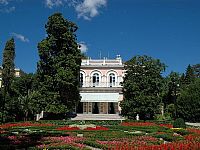

Villa "Angiolina" is the building that certainly marked the beginning of the tourist epoch in the history of Opatija. Saint Jacob’s Church Pending its building in 1844. (actually a reconstruction of an older building owned by baron Haller von Hallerstein), Opatija was a relatively large settlement with about 120 houses, clustered mainly around plots further away from the sea coast and chiefly oriented towards fishing and seafaring.
Read More »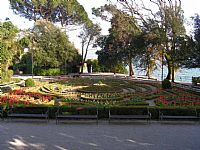
The central Opatija park is a horticultural monument covering an area of 3.64 hectares. It is divided into 60 fields and about 159 plant species grow here. A great number of plants originate from distant parts of the world and they are not typical for this region.
Read More »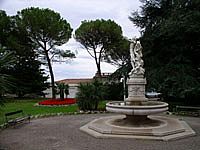
The fountain Helios and Selena is located in beautiful park opposite the Imperial hotel near the church of St Jacob.
It's the work of the sculptor Hans Rathautskog from Graz, by Madonna, and to Theodor Billroth. The fountain represents the Sun and the Moon, the personification of the mythological characters brother and sister.
Read More »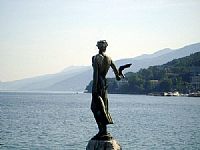
Work of the sculptor Zvonko Car, placed near the sea in 1956. It is one of the symbols of Opatija.
Read More »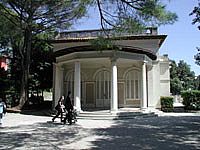
An exhibition space named after the physician dr. Juraj Matija Sporer (in 1859 he suggested the establishment of a society for the construction of Opatija as a sea resort and a natural health center)
Read More »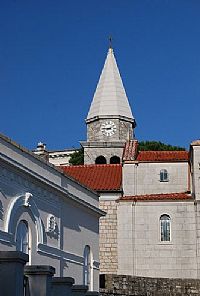
Built on the foundations of the past Benedictine monastery, it is mentioned for the first time in 1439. To the left, near the church, the monastery and the cloister are located , with a well in the middle. Between the church and the monastery stands the stone bell-tower.
Read More »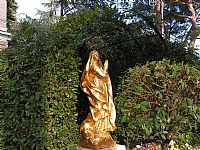
The original of this gilded replica was originally located where today stands the famous “Girl with the Seagull'', watched over the souls of count Kesselstatt and countess Fries who had drowned in 1891 close to this cape.
Read More »
General Manager of the Southern Railways Association, Friedrich Julius Schüller, with the capital of which he bought "Villa Angiolina", built "Hotel Kvarner", its annexes, other hotels and rest centres. He is considered to be the predecessor of the development of Opatija as a modern tourist resort.
Read More »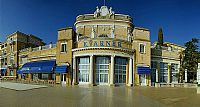
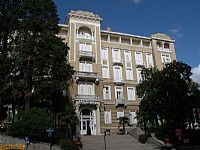
This was the second hotel to be built in Opatija. As soon as it became evident that the Kvarner would not be able to accommodate the steadily increasing number of guests, the Southern Railways began building a new hotel.
Read More »